Tuesday, 23 April 2013

An Open Letter To President Obama.


Dear Mr. President,

I salute the brilliant humanistic speech about the Palestinian people that you made on your most recent trip to Israel. The fact that it was delivered to an audience of Jewish students in Jerusalem made it all the more groundbreaking and important. You said, “Put yourself in their shoes — look at the world through their eyes. It is not fair that a Palestinian child cannot grow up in a state of her own, and lives with the presence of a foreign army that controls the movements of her parents, every single day.”

Awareness: I, myself, am Jewish and care deeply for my people. But, many of us have forgotten our history. We have forgotten that the Nazis said evil was in our blood. They took our houses, arrested our fathers, killed our children, and ghettoized our families. They wanted to purify their land by ridding it of our kind. Our crime? We were Jewish! In order to put ourselves in The Palestinians’ shoes, all we have to do is remember our past. We were in their shoes and we asked where are our oppressors’ hearts? Have they no mercy? Where are the objectors among them?

The lessons the Holocaust taught me.

We must never be bystanders to human suffering.

“Never again” means never again for any people ever again.


When the horrors of the Holocaust were uncovered, there was a need to find a place for the survivors to go. The west, didn’t want us so they were happy to give us Palestine. And they were happy to buy the fallacy that Palestine was “a land without a people for a people without a land”, and that we made the desert bloom. Let’s be honest, Palestine already had a people, the Palestinians, and the vast majority of whom were not Jewish.  Jerusalem, Bethlehem, Acre, Haifa, Nazareth, Jaffa and many more cities were already well-developed, and made of stone, with ports, universities, hospitals, schools and hotels. There were trains and, international trade and travel. The desert we brought to bloom was the land on which we built Tel Aviv in 1909, and that’s it.

In 1947, when the UN proposed to partition Palestine into a Jewish, and a Palestinian state, and the Palestinians objected claiming that they wanted a secular democracy where Jews, Christians and Muslims would live together with equal rights, the west rejected their proposal.


We had just survived the Holocaust, and we felt that we could only rely on ourselves and we must do whatever it takes to survive, instead in November, 1947 we began to execute our Plan Dalet to ethnically cleanse Palestine of the non-Jewish majority. We took, by force of arms, the cities of Haifa and Jaffa, creating hundreds of thousands of Palestinian refugees in the process. Having seen the devastation and injustice caused by Plan Dalet, five Arab countries decided on military intervention, but 60,000 barely armed, and poorly trained and were no match for the 90,000 heavily armed, and well trained Zionist soldiers. When we won the war and took even more Palestinian land than the UN gave us, we told the world David beat Goliath and the west was happy to believe it.  

But we need to be honest. The Palestinians have paid the price for the Holocaust. We ethnically cleansed as many as we could which is well-documented by Israeli historians including from the left Ilan Pappe to the right Benny Morris. We kicked them out, refused to let them back in. We looted their houses, we took the beautiful ones for ourselves and then we razed 500 of their villages so they wouldn’t have a place to come home to. We were refugees, but then we came and took Palestine and made them refugees. When we wouldn’t let them return, they resorted to violence, so we called them terrorists and made it stick.

Only awareness can set us free, because awareness leads to understanding, and understanding leads to change.  We cannot turn a blind eye to the truth. We have the power now, but that won’t last if we don’t give others what we want for ourselves. The greatest lesson I learned from Judaism was articulated by Rabbi Hillel, “That which is hateful to you, do not unto another. This is the whole Torah. The rest is commentary.”

We cannot keep repeating our same history: We are persecuted, we overcome, we abuse and we are persecuted again. The Palestinians’ crime is that they are not Jewish because if they were, we would accept them with open arms. I lived in Israel for seven years. It’s easy to live there and never notice anything. We were segregated from the Palestinians and taught that they are evil and violent and less than human, that their lives don’t matter.

We managed to convince the US that we, with one of the strongest militaries in the world, a nuclear regional superpower are threatened by an unarmed population that has no army, no navy, no airplanes, no tanks, and no nuclear weapons, where the majority of them are children.

Mr. President, I want you to know that I saw the way the Palestinians were treated, and I felt embarrassed to be both American and Jewish. You’re no doubt aware, Zionism is secular nationalism, and couldn’t be further from Judaism. I wanted to help. I did my BA at the Hebrew University in Jerusalem and my MA at Harvard both in Middle Eastern studies. I’m also a lawyer trained in human rights. But there was little that could be done until I read The Kite Runner, and realized a writer could reach into readers’ hearts and change them forever. I wrote The Almond Tree in the voice of a Palestinian Muslim. I became him in an attempt to reach my people. I don’t try to say who is right and who is wrong, I just appeal to our values of democracy and equal rights for all. All sides of the conflict are embracing my book, as well as people who have no interest in the subject, because I tell a very human story about a boy who, against all odds, is able to achieve what others have only dreamed.

I know that our government has the power to help the Israeli government to do the right thing. You will remember that not long ago the United States had a similar relationship with South Africa. The Reagan administration considered Nelson Mandela a dangerous terrorist, and the white Afrikaner government a close ally. The Apartheid government of South Africa knew that they would never have to dismantle their Apartheid system of control and discrimination unless the United States told them to do so. For South Africa, it didn’t matter that the rest of the world condemned apartheid, and called for democratic reforms to take place, as long as the United States didn’t complain, and for many years it did not complain. South Africa ignored the rest of the world. Democracy and equality for all came to South Africa when we changed our policy. If we change our policy now, we can help Israel revisit its core Jewish values, and do the right thing for everyone. 

David Broza, one of Israel’s greatest singers, and Guillermo Fesser, a Spanish TV and Radio host have joined me to form The Almond Tree Project. We will kick off with, our first event will be in Utica, NY, on April 23RD event. I wanted you to know that we are responding to your call to action.

Michelle Cohen Corasanti
Author of the Almond Tree

Thursday, 4 April 2013


Hi Everybody.  I've just joined this blog group so I though I'd start by reposting the most important thing that I’ve ever posted.

Here Goes:

I've not blogged for nigh on a year now but I’ve jut finished reading an absolutely brilliant book, and decided that I simply had to get back on the blogosphere to share it with the world. I binned all the other rubbish I’d written in the past, and will make this my new start.
The book is called The Almond Tree, and it was written by Michelle Cohen Corasanti. The fact that its a beautifully written, and excellent story is certainly a bonus, but I feel the message is more important.
I’ve contacted the author, and she gave me permission to use her press release. I glad she did because I don’t think I’d be able to introduce it to you very well myself.

 Here you go:
The Almond Tree
by Michelle Cohen Corasanti
NEW NOVEL DEMYSTIFIES ARAB-ISRAELI CONFLICT AMID FEAR AND HATE AND INSPIRES PEACE IN ALL NATIONS
“If ever peace is to become a reality between Israel and Palestine, it will be because of the influence of books such as this.” – Les Edgerton, author of Hooked and others.
Against a background torn from the pages of today’s headlines, The Almond Tree, by Michelle Cohen Corasanti, tells the inspirational story of a Palestinian boy whose devastating decisions impact on his family and others for years to come. The insightful and inspirational story of Palestinians living in Israel and Gaza, as told by a Jewish American author. The Almond Tree follows a Palestinian boy’s journey of survival and discovery exploring themes of redemption, family sacrifice and the benefits of education and tolerance.
The Almond Tree is a provocative, tender and poignant novel that recasts a culture frequently seen in the news but often misrepresented and more misunderstood. The book’s universal message of resilience, hope and forgiveness will hit home with anyone who has faced adversity.
Cohen Corasanti’s novel brings humanity and clarity to the Arab-Israeli conflict. Her personal experience of living in Israel for seven years while attending high school and obtaining her undergraduate degree in Middle Eastern studies from the Hebrew University gave her the perspective, insight and ability to craft this story.
“Throughout my novel, I fictionalized real people and occurrences. In the news, they were a statistics. In The Almond Tree, these people have a voice,” says Cohen Corasanti. “I also want to teach the next generation about tolerance and the importance of celebrating our differences. I want my children to know that they can learn, educate, stand up for their beliefs and make a difference in their community and their world.”
The Almond Tree also includes the following themes:
 Humanizing the Arab-Israeli conflict, a world away
 The power to successfully integrate different faiths to advance humanity
 How education begets peace and how ignorance begets war
 That peace brings security, security doesn’t bring peace
 Surviving great loss, moving forward, redemption
 How the United States’ influence can dictate international change
 The character one must possess to take a monumental leap of faith
 The importance of thinking outside the box
 Forgiveness and human resilience after disaster or tragedy
 How all people have value, even our enemies
 Conflict resolution must include putting yourself in their shoes
 When two brothers take two different paths one can lead to peace the other to despair
Cohen Corasanti’s characters convey the spirit of a resilient culture through their actions, their relationships and, most convincingly, through the hero, Ichmad’s voice. From his overbearing mother to the death of a sibling, from the pressures of an interfaith relationship to the fallout of discrimination, Ichmad confronts each challenge with strength and determination, whether it is political, religious or otherwise. The story is unique in its delivery, approach and resolution. It inspires options for Jews seeking conflict resolution with Palestinians as well as anyone who endured extraordinary hardships and has come out on the other side. The Almond Tree also provides a voyeuristic look into a life we would never wish on our own children.
“The Almond Tree is a novel that matters, that reminds us of what makes us all different and, more importantly, what makes us all the same.” —Mark Spencer, author of The Masked Demon, A Haunted Love Story, and The Weary Motel
 A couple of Sound bites from Michelle:
“May the battles we fight be for the advancement of the human race“
“ With my novel, I tried to shine a light on the situation so bright that the whole world would see.”
Here’s a link to here website - http://thealmondtreebook.com/
So there’s your introduction, I’ll be back tomorrow with some more to say on the subject.
UK Amazon Link:

Monday, 1 April 2013


         In Celebration of its 85th Anniversary The Stanley Presents

The Almond Tree Project

Tuesday, April 23, 2013
The Stanley, Utica NY


Native Utican, Michelle Cohen Corasanti, who lived in Israel for seven years and has an undergraduate degree from Hebrew University, and graduate degree from Harvard in Middle Eastern Studies has written a novel called The Almond Tree, which has become an international bestseller. Even though this is her first book, she’s already distinguished herself enough to have upcoming speaking engagements at the  Florida International Book Club, The Women’s Alliance and most prestigiously of all, the UN Commission for the Gulf Coast to name but a few.
This has been put together to celebrate the positive effects that The Almond Tree book is having around the world. In the book, its author, Michelle Cohen Corasanti, discovers what to her had been an unknown world, and through it, projects a perspective conveying hope. In her narrative, Michelle gives voice to the Palestinian people without apportioning blame, or promoting hatred.
In highlighting their struggle, she hopes to promote a dialogue which will bring about peace in the region. Despite being a Jewish American woman, she does a brilliant job of writing from the point of view of a Muslim Palestinian male. This was, as one can easily imagine, a struggle for her, and her success in doing so is a testament to her writing skills. If we all had her capacity for empathy, would there be any more wars?
The book, which is based  on her real-life observations, proposes that we examine this wonderful part of the world by putting ourselves in the shoes of its denizens.
Guillermo Fesser; one of the bright lights of  Spanish TV and Radio, has interviewed everyone from Jack Nicholson to the King of Jordan; is responsible for putting together The Almond Tree Project, which is so-named in honour of the book , will be interviewing Michelle at the event.  Also involved in The Almond Tree project is David Broza who is one of the greatest Israeli singers, songwriters and musicians of all time. He will be singing the Almond Tree song that was inspired by Michelle’s book along with other songs.
The night will also include Israeli peace activist Miko Peled. His grandfather signed the Israeli declaration of independence, his father was a general in the Israeli army during the ’48 and ’67 conflicts, and his beloved niece was killed by 2 suicide bombers as she shopped for school supplies.  He is the author of The General’s Son and would also like to show a better way.  To round the evening of, we will have Palestinian superstar singer, songwriter and musician Mira Awad.
6:00 PM: Special lecture by Peace Activist and author of The General’s Son, Miko Peled- Tickets: $10

7:30 PM: The Almond Tree Project: Tickets: $10, $20, and $40, Students: $8;  Group Pricing Available

The Stanley Box Office 259 Genesee Street, Utica
315-724-4000
www.thestanley.org

All Proceeds to Benefit The Stanley
For more information, please visit www.thealmondtreeproject.com


Saturday, 30 March 2013

Proud2bb00kobsessed: Spoilers in reviews

Proud2bb00kobsessed: Spoilers in reviews: So I didn't want to film a video over this subject at the moment but I did feel it was necessary to talk about spoilers in book reviews....

In the Skin of The Palestinians


America is the most pro-Israel nation on Earth. Even more than Israel itself. And Israel is the country that more money would put the United States in aid for development: 3,053 million annually. Three billion U.S. for a country with a per capita income similar to Spanish. An amount greater than the sum of all U.S. aid destined to the rest of humanity. And in better condition. The U.S. administration gives the Jewish state the total sum in the first month of the fiscal year. Unlike the other nations, whose aid reaches them in installments, quarterly, and almost always leaving for last the pinch largest two thirds.
How do they manage to get so much help? The first reason is religion. Does the Jewish religion? No, the Christian. United States is deeply Christian and has large pockets of fundamentalist population.Anyone who has walked a Baptist church in Georgia or Texas know what I mean. Millions of people accept on faith that God gave the land to the chosen people of Israel and nobody has the right to take it away. Or, what comes to the same thing, that while the U.S. is a staunch ally of Israel, the nation will remain blessed by divine grace.
The second reason is the Israel lobby in the U.S. has: AIPAC. The Public Affairs Committee powerful Americo-has convinced Israeli politicians, media and ordinary citizens, that the interests of Israel and the U.S. are exactly the same. A masterfully cultivated distortion due to the ignorance of the people about the history of Palestine. AIPAC preaches on this side of the Atlantic that the Palestinians will never be peace, because they do not want it. So AIPAC takes a threat. And Hamas is declared a terrorist organization so that when Americans see CNN live on the bombing of Gaza not feel sorry. And feeds the winds of war with Iran because, while staff at the borders are fixed, there is no time to analyze what happens inside.
Many U.S. politicians continue to eat from the hand of AIPAC and while their constituents do not demand a change agenda, are unlikely to change position by choice. Not that AIPAC directly fund their campaigns, but important influences Jewish fortunes to do so. It relies on a large core of American Jewish population, which curiously notable for having a very liberal political orientation in all areas, is reluctant to shed the slightest criticism of Israeli policy. There are historical reasons well known and very respectful to understand this conspiracy of silence.Emotional blackmail also splashed a large section of the press; tending to forget that conflicts are usually always two versions. And in fact, you can read much more critical items Bibi Netanyahu in the Israeli daily Haaretz , in U.S. newspapers.
And so we will be until the Americans are not offered, as suggested by its president, on the skin of the Palestinians. Until we understand that the legitimate aspirations of these people are not going in a different direction than that of peace and that their wishes are not far from those of any other human being who just wants their children to bed at night knowing that will not lack education, no food, no shelter, no ceiling.
And we will continue until U.S. voters not lobby their congressmen and senators to demand that the government of Israel to stop the occupation of territories that do not belong. To sit down and negotiate with the Palestinians on equal terms. For while Israel gets from the U.S. public a green card to do what he wants in Palestine, we will use the aid flowing annually from Washington for this purpose. Suffice it to recall the example of South Africa. For Reagan administration officially Mandela was a dangerous terrorist. And the separatist government of South Africa knew that, while the United States was on their side, which told the world cared three peppers.
The bad news is that, for Americans to get in the skin of the Palestinians, it will take a miracle. The good: the miracle that is already happening. And not from any political negotiation table. Neither of Madrid, and Oslo. The miracle is happening thanks to a fiction book that I predict will become one of the biggest bestsellers of the decade. This is the first novel of a Jewish New Yorker, Michelle Cohen Corasanti, and is entitled The Almond Tree. For the time being only in English, The Almond Tree, which is available on Amazon . It is an epic novel, a drama of the proportions of Kite Runner , but set in Palestine. A beauty. A story that grabs you from the first page and putting you soul to the Palestinians without lifting the finger at anyone, without transmitting hatred. A proposal to live in peace. An adventure that brings you into the magical world that travelers used to cross on horseback or camel towards Beirut, Amman or Cairo. A land where Christians, Muslims and Jews shared their traditions for centuries. Where the children inherited the land, generation after generation, to keep the clan together. Where modesty was a way of life and a man was worthless if not defending his family. Where the courage not consider the absence of fear, but the abundance of generosity. Where children learned the fundamental principle of life: decency.
The Almond Tree is the saga of a boy who, when arriving obstacles must look inward and understand that soldiers are only human beings and that war is merely politics. From a young man who must discover that success is not in never falling, but in rising every time you fall. Because it is impossible to go back in time and change the beginning, but you can always start over to change the ending.
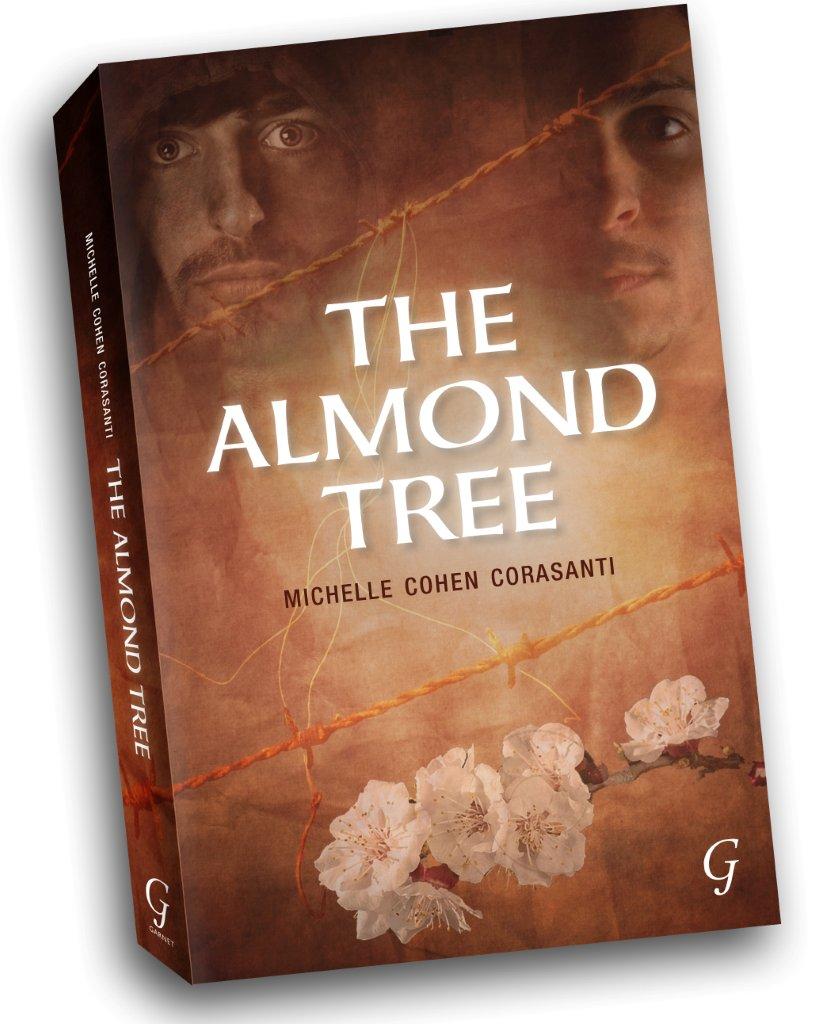
2013-03-25-20130324TheAlmondTreeBookcover.jpg

This book can get, after reading it, Americans check  out  the screens of CBS, FOX, NBC or CNN, instead of anonymous terrorists, identify the faces of women with children, grandparents with grandchildren, parents with brothers ... Way to work, back to school, shopping in the market ... People who can not pick their own oranges from trees because they have surrounded the Israeli military. Youth who can not accept their scholarships in Harvard or Yale because Israeli authorities do not allow them to leave Gaza. And then, those same Americans who today are silent through ignorance, questions will be asked. Change their voting intentions, demand to know the fate of their donations ... Because Americans do not get a lot of world news, but read books. And watching movies. And listen to songs. And through art can go, without trying to advance, to step into the shoes of the Palestinians. Then we begin to glimpse the hope in solving a conflict that weighs us all too.

Monday, 25 March 2013

An Appeal On Behalf Of The Palestinian People


Hi Everybody. I’ve not blogged for nigh on a year now but I’ve jut finished reading an absolutely brilliant book, and decided that I simply had to get back on the blogosphere to share it with the world. I binned all the other rubbish I’d written in the past, and will make this my new start.
The book is called The Almond Tree, and it was written by Michelle Cohen Corasanti. The fact that its a beautifully written, and excellent story is certainly a bonus, but I feel the message is more important.
I’ve contacted the author, and she gave me permission to use her press release. I glad she did because I don’t think I’d be able to introduce it to you very well myself.

 Here you go:
The Almond Tree
by Michelle Cohen Corasanti
NEW NOVEL DEMYSTIFIES ARAB-ISRAELI CONFLICT AMID FEAR AND HATE AND INSPIRES PEACE IN ALL NATIONS
“If ever peace is to become a reality between Israel and Palestine, it will be because of the influence of books such as this.” – Les Edgerton, author of Hooked and others.
Against a background torn from the pages of today’s headlines, The Almond Tree, by Michelle Cohen Corasanti, tells the inspirational story of a Palestinian boy whose devastating decisions impact on his family and others for years to come. The insightful and inspirational story of Palestinians living in Israel and Gaza, as told by a Jewish American author. The Almond Tree follows a Palestinian boy’s journey of survival and discovery exploring themes of redemption, family sacrifice and the benefits of education and tolerance.
The Almond Tree is a provocative, tender and poignant novel that recasts a culture frequently seen in the news but often misrepresented and more misunderstood. The book’s universal message of resilience, hope and forgiveness will hit home with anyone who has faced adversity.
Cohen Corasanti’s novel brings humanity and clarity to the Arab-Israeli conflict. Her personal experience of living in Israel for seven years while attending high school and obtaining her undergraduate degree in Middle Eastern studies from the Hebrew University gave her the perspective, insight and ability to craft this story.
“Throughout my novel, I fictionalized real people and occurrences. In the news, they were a statistics. In The Almond Tree, these people have a voice,” says Cohen Corasanti. “I also want to teach the next generation about tolerance and the importance of celebrating our differences. I want my children to know that they can learn, educate, stand up for their beliefs and make a difference in their community and their world.”
The Almond Tree also includes the following themes:
 Humanizing the Arab-Israeli conflict, a world away
 The power to successfully integrate different faiths to advance humanity
 How education begets peace and how ignorance begets war
 That peace brings security, security doesn’t bring peace
 Surviving great loss, moving forward, redemption
 How the United States’ influence can dictate international change
 The character one must possess to take a monumental leap of faith
 The importance of thinking outside the box
 Forgiveness and human resilience after disaster or tragedy
 How all people have value, even our enemies
 Conflict resolution must include putting yourself in their shoes
 When two brothers take two different paths one can lead to peace the other to despair
Cohen Corasanti’s characters convey the spirit of a resilient culture through their actions, their relationships and, most convincingly, through the hero, Ichmad’s voice. From his overbearing mother to the death of a sibling, from the pressures of an interfaith relationship to the fallout of discrimination, Ichmad confronts each challenge with strength and determination, whether it is political, religious or otherwise. The story is unique in its delivery, approach and resolution. It inspires options for Jews seeking conflict resolution with Palestinians as well as anyone who endured extraordinary hardships and has come out on the other side. The Almond Tree also provides a voyeuristic look into a life we would never wish on our own children.
“The Almond Tree is a novel that matters, that reminds us of what makes us all different and, more importantly, what makes us all the same.” —Mark Spencer, author of The Masked Demon, A Haunted Love Story, and The Weary Motel
 A couple of Sound bites from Michelle:
“May the battles we fight be for the advancement of the human race“
“ With my novel, I tried to shine a light on the situation so bright that the whole world would see.”
Here’s a link to here website - http://thealmondtreebook.com/
So there’s your introduction, I’ll be back tomorrow with some more to say on the subject.
UK Amazon Link:

Sunday, 10 March 2013

A Powerful Historical Saga By JAMAL KANJ


A Powerful Historical Saga


THE ALMOND TREE
by
Michelle Cohen Corasanti


Reading novels is not high on my “to do” list, although I have made exceptions for those with social or historical elements.The Almond Tree was one of those exceptions and it turned out to be a moving and
powerful novel based on historical events,which the writer weaves together harmoniously in more than 300 pages.It is the type of story that will keep youwondering where reality ends and fiction
starts and was an interesting read, even for someone who rarely appreciates fiction.When I started it I knew nothing aboutthe writer, but as the pages turned I discovered a person who was well-versed in the Palestinian and Jewish cultures.This was apparent in the use of local lexicons and by discussing events less commonly known to people from outside the conflict zone.I learned later that the writer was born
into a typical Jewish, Zionist environment in the US and grew up believing in the long-held myth that “Jews found a land without people for a people without land and made the desert bloom”.She was taught that “Jews were always the victims” and that “arabs and Muslims… hated Jews because they were
Jewish”.at 16 she went to study Hebrew inIsrael, where the myths and racist stereotypes were institutionally reinforced all over again.
However, it was when she spent a summer in France and – for the first time in
her life – came across arabs from Lebanon
that her life was transformed.
She was exposed to a different narrative and, with an open heart and mind,
her curiosity took her back to Jerusalem to
pursue Middle East studies at the Hebrew
University.
She was the only american in a programme full of “Jewish Israelis and
Palestinian Israelis”.
Craving the truth, she befriended native
Palestinians and discovered the descendants of people she always believed never
existed.
Realising that everything she had
been taught “was a lie”, the writer left
Jerusalem to attend graduate school at
Harvard University, majoring in Middle
Eastern history, and also law school specialising in international and human rights
laws.
Her book focuses on the human side of
Palestinians’ trials since the creation of
Israel up until contemporary occupation,
illegal settlements and war.
The novel is good reading for anyone
seeking to grasp the inherent contradictions
and complexity of the Palestine question.
It describes how some were able to overcome all odds, while others were swept up
in the vortex of perpetual conflict.
The Almond Tree tackles individual and
institutional Israeli racism towards native
Palestinians, as well as the inner struggle
among Palestinians and Jewish communities for mutual acceptance.
Characters in the book range from a
highly educated Palestinian who struggled
to break through the walls of Israeli racism, worked with Israelis and ended up
marrying a Jewish-american woman.
On the other hand there is a man who
rejected his brother’s perceived submission
to the enemy and who was driven into exile,
moving from one ideological extreme on the
left to become a leading figure in a radical
Palestinian organisation on the right.
There is the Jewish-american woman
fighting her “progressive” parents’ inhibited
racism to marry a Palestinian, as a young
Palestinian man struggles to overcome his
mother’s trepidation before marrying a
Jewish girl.
However, the writer also deals honestly
with the desperate environment that drives
young Palestinians to become suicide bombers.
One chapter in the book discusses in
great detail the case for and against military confrontation with Israel and while
the deliberations do not seek to persuade
the reader one way or another, they help us
better appreciate conflicting views.
not many writers have made the effort
to examine the Palestinian-Israeli conflict
outside the polemic historical discourse
and, historical interpretations aside, The
Almond Tree is a journey that puts the
reader in touch with people directly affected by the perceived “irrational and convoluted” Middle East conflict.
It is one author’s humble contribution
to help people, especially Zionists, remove
their subliminal bigoted blinders and is a
message that we should leave our parochial
shells and discover humanity outside the
tribe.
Jamal Kanj is an author and Gdn
columnist who writes frequently on Arab
issues and is an expert on the Palestinisn-Israeli Conflict.